


Kenshō - Noord Holland, Netherlands | Long Island NYC, United States | Saitama, Japan @kensho_suzuoka

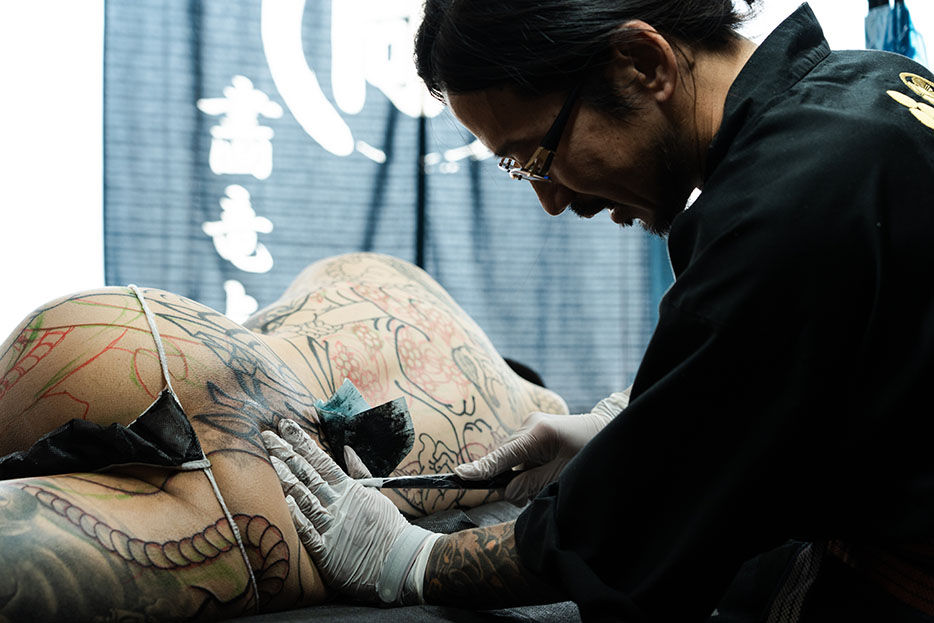
Master of traditional Japanese Tebori, Kensho is an artist who bridges East and West through his craft, currently working in Noord Holland (Netherlands), Long Island, New York (United States), and Saitama (Japan). Recoanized as an Honorary Lecturer of Traditional lapanese Arts by the AAA Abstract Art Academy, and an ITIC International Professor License Holder in cooperation with the European Union and UNESCO, Kensho is devoted to preserving and elevating the art of Teboriblending lechnique, spirituality, and a profound connection to a disciple of a legendary Japanese tattoo master, he chose to follow his own path after his teacher's passing, guided by the philosophy of Haboku (5)creating beauty by Iranscending form without betraying Iradition. With over two decades of experience, his work reflects discipline, humility, and a conslant pursuit of perfection. Beyond taltooing, Kensho leads initiatives to preserve traditional Japanese craftsmanship, such as the WAJIMA- IREZUMI Project, which fuses tattoo art with Wajima-nuri lacquerware, donating all proceeds to support workshops affected by the Nolo Peninsula earthquake.
Sponsored by DermalizePro and ColorDragon Needles, Kensho embodies ihe harmony between tradition and innovation. As he often says:
"A true craftsman never stops learning. The path of Tebori has no end.'

1.How would you describe your personal style within Tebori, and what are the elements that, for you, are essential in a tattoo made with this technique?
My style has always been based on the knowledge inherited from my predecessor, a traditional Japanese tattoo master. Japanese traditional tattooing has its own set of rules—forms that have evolved into an aesthetic system—and I believe that this stylistic discipline is what elevates the work into an art form, appreciated around the world. Earlier this year, my predecessor passed away. After much reflection, I decided to change my name to Kensho—not to live as the second generation, but to stand on my own two feet in Japan, to further sublimate what I inherited, and to create my own worldview. In Japanese calligraphy, there is a technique called Haboku (破墨). It means to layer ink over ink, using the natural bleeding and gradation to express depth and spontaneity. Although the word “破” means “to break,” it does not signify destruction, but rather transcending form to create new beauty. For me, Haboku represents the spirit of staying rooted in tradition while going beyond its boundaries without betraying them. That is how I walk my own path. Tebori—hand tattooing—is fundamentally different from machine tattooing. If I were to compare, it is like carving wood with a chisel versus engraving it with a power tool. With a machine, the needle moves automatically in vertical motion and the artist simply guides it along the skin—much like writing with a pen. In Tebori, each puncture is controlled by the artist’s hand. Even a straight line must be executed with precision—if it deviates by even 0.1mm, it fails. It requires extreme focus and refined technique. This is not something that can simply be taught or imitated. It demands both natural dexterity and years of sincere, continuous training. My predecessor often said, “You have only reached the starting line after twenty years of Tebori.” There is no end to the training of handcraft—there are always new discoveries. After nearly twenty-four years, I finally feel that I am entering a stage of true growth. A humble and learning spirit—this, I believe, is essential to Japanese Tebori.

2.What was your story with Honke Horiyoshi, and what led you to become his successor?
I was originally just one of my predecessor’s clients. At nineteen, I began getting tattooed through a friend’s introduction, but that artist lacked both skill and knowledge. After multiple cancellations and poor work, I grew frustrated. At that time, there was no internet—just the second issue of Tattoo Magazine—so finding a good artist was extremely difficult. Through a mutual acquaintance, I met one of my predecessor’s disciples, who introduced me to him. As I kept visiting the studio, my predecessor seemed to take a liking to me and began talking with me after each session. One day, he suddenly asked, “Would you like to become a tattoo artist?”
I immediately said yes. Traditionally, becoming an apprentice to a Japanese tattoo master is an extremely narrow path—many are turned away. In the past, it was said that some hopefuls waited for days, even through rain, outside the master’s door to be accepted. I was truly fortunate. And to be accepted into the lineage of a Tebori master—rarer still. In Japan, the word minarai (見習い)—meaning “to watch and learn”—captures the apprentice’s role. You observe the master, think for yourself, and seek meaning even in the briefest words the master speaks. In my case, I was only taught how to trace designs, make the basic tools, and assemble needles.
The most crucial aspects were left for me to discover. When I tried practicing on my own leg, the bleeding wouldn’t stop. Through constant trial and error, I improved little by little. In Japan, black ink is made from solid ink sticks, but no one tells you which brand is suitable for tattooing. I tried many brands on my own skin—sometimes causing terrible reactions—but those experiences built my habit of experimentation and research. My predecessor had more than thirty apprentices, but almost all gave up or switched to machine tattooing. Even after becoming independent, I continued to meet with him regularly, receiving guidance and sharing stories from my travels. Looking back, I think he truly enjoyed watching me grow. Before I knew it, our bond had become deeper than that of parent and child. Although I cannot share the detailed circumstances, I succeeded him by adopting one character from his real name, becoming Kensho Nidaime (the Second Kensho).
Later, perhaps feeling some loneliness, he began calling himself Honke Horiyoshi Kensho Shodai—the First Kensho of the Honke Horiyoshi line.
3.You have participated in international conventions and traveled extensively; what impact do those journeys have on your work?
Skin quality differs greatly from country to country. Techniques that worked perfectly in Japan didn’t always work overseas, and that forced me to rethink and refine my tools. Had I only tattooed a few foreign clients in Japan, I would never have realized these differences. Working abroad also meant adapting to unfamiliar, often inconvenient environments. I have tattooed in booths facing huge speakers blasting music, under scorching outdoor conditions while drenched in sweat, surrounded by flies—and once at a venue where every toilet was overflowing (laughs). Yet such experiences strengthened both my technique and endurance. I usually travel alone. Through years of solo journeys—some involving lost luggage and stolen tattoo kits—I’ve learned to stay calm in any situation. I’ve also met countless artists around the world, and their techniques, styles, and ways of life deeply influenced me. Even artists working with machines, in completely different genres, have given me insights that I could apply to my own style. My attitude of constant curiosity and learning definitely comes from my apprentice days. Traveling opened my eyes to how warmly tattoo culture is accepted around the world, and how highly Japanese traditional tattooing is respected. Before these journeys, I realize I was narrow-minded and stubborn. Travel changed that—it shaped both my work and my worldview.
4.What does working with the Tegaki technique mean to you, and how does it contribute to your artistic expression?
I have no intention of denying the stencil method. Every artist should work in the way that best suits them, and there are many who create amazing pieces that way. What matters most is mutual respect—acknowledging and uplifting one another as both artists and human beings. As for me, being one of the few remaining Tebori artists in Japan, I choose to draw directly by hand—the traditional way. Because the human body is full of curves, sketching directly onto the skin allows the design to flow more naturally and gives life to each line. A hand-drawn design feels alive—it carries a spirit within it. In Japan, we believe that the spirit dwells within things that are made by hand. That’s why even the intricate kimono patterns in my designs are all drawn freehand. From an artistic point of view, I believe people find beauty in imperfection. Just like in painting or traditional crafts, something created entirely by machine lacks warmth. There’s a unique charm in the subtle irregularities of handwork—the living pulse that only human touch can create.

5.Could you tell us about your craftsmanship?
I am still in the middle of my journey as a craftsman, not yet at the stage to pass down my skills to others. However, I can describe the ideal form of design and technique within my lineage of traditional Japanese tattooing. Figures should neither look too cartoonish nor overly realistic. Their poses must carry the distinct dynamism of ukiyo-e. While faithfulness to ukiyo-e is important, traditional Japanese tattooing also has its own established method for depicting people—a language of form that can only be learned through observing many works. As for Tebori, I have recently begun intentionally leaving certain parts rough, preserving textures that only hand-carving can create. In contrast, areas requiring delicacy are executed with precision. By balancing these elements, I aim to express contrast, dynamism, and life throughout the entire piece.
6.What did the international recognitions for your preservation of traditional Japanese art mean to you?
It is a great honor that my efforts to preserve and elevate Japanese traditional art have been recognized internationally. It means that the knowledge and techniques I inherited from my predecessor—and transformed through my own sensibility—have been acknowledged as a genuine form of artistic expression. I am deeply grateful. That said, I am still on the path of learning. I strive to remain humble, sincere, and dedicated to continuous growth. How far I can climb within this lifetime is my personal challenge. And when the time comes to retire, I will pass on what I have inherited to my successor.
7.How important are the space, lighting, materials, and sense of tranquility in your studio for your creative and technical process?
I believe human beings are deeply influenced by sound (frequency), space (vibration), and silence (energy). For that reason, my workspace is filled with objects that carry personal meaning and resonance. In my studio, I keep books, a small shrine, and the works and photos of my predecessor, grandfather, father, and brother. By surrounding myself with these presences, my mind aligns naturally, allowing me to focus entirely on tattooing. Every morning, I burn Japanese agarwood to purify the energy of the space, offer prayers at the shrine, and dedicate my full spirit to my work. The room is illuminated with warm, gentle light, while only the working lamp is bright—designed so my attention remains completely on the tattoo. Ultimately, however, a true artist must be able to focus anywhere. My travels have trained me for that—I once worked for forty-eight hours with only three bananas to eat and six hours of sleep in total. My tools are my soul. I make them all myself. Through crafting, a part of my spirit resides in them—they become an extension of my body. Each artist’s tools, their shape, material, and method of crafting, are deeply personal and secret knowledge.
8.The preservation of Tebori and traditional Japanese tattooing seems central to your work. What do you hope to achieve in the coming years regarding keeping this tradition alive, innovating within it, or passing it on?
Traditional Japanese tattooing is both an art form and a craft—one of Japan’s cultural heritages. Over centuries, our predecessors refined their techniques through endless trial and error, passing them down to the next generation. Within these tattoos lie the prayers and emotions of those who wore them. Many traditional crafts in Japan face extinction as their artisans age and successors disappear. I wanted to find a way to give back to Japanese tradition through my art. When the major earthquake struck the Noto Peninsula last year, I felt compelled to act. The region’s city of Wajima—famous for Wajima-nuri lacquerware—was devastated. Workshops collapsed, tools were lost, and the younger generation had nowhere to learn. Recovery remains painfully slow, and many residents have left. I collaborated with the surviving artisans to create a special Wajima-nuri x Irezumi project. The first work was a lacquer soup bowl embodying the full technique of Wajima-nuri, completed over nine months by nine craftsmen in more than 120 processes. Details are available on my website under the page “WAJIMA-IREZUMI.” A promotional video is currently being produced by a digital creator friend, and once completed, we will promote it online and at exhibitions abroad. All production and promotion costs are paid out of my own pocket, and 100% of the proceeds go directly to the Wajima Kōbō Nagaya workshop. I plan to continue supporting other traditional crafts in the same way. I believe the spirit of a nation resides in its traditional culture. My goal is to help pass on these traditions—and the spirit behind them—to the next generation, without giving up. Japanese people have a unique tendency to devote their entire lives to mastering one pursuit. And when anything is pursued to its utmost limit, it naturally becomes art. I hope people will experience Japan’s traditional craftsmanship firsthand—to feel the spirit that lives within each handmade work. I also believe that true happiness can only be found through the happiness of others. Fulfilling one’s egoistic desires leads only to emptiness. If we ourselves are not happy, we cannot make others happy. So first, make the people important to you happy, and from that foundation, act—when time and heart allow—for someone else, or for the culture of your country. If even one person reading this interview is inspired to take such a step, I would be deeply grateful.
9.If someone wants to get in touch with you, what is the best way to do so?
For security reasons, I do not accept direct messages on social media. Please contact me through the contact form on my website: https://japanesetattoo.com
YouTube @kensho_suzuoka
Website: japanesetattoo.com
Traditional Tattoo Association


Comments