


Anastasiia Mikaskina Toronto / Canada @_red_head_tattoo_ @redheadtattoostudio redheadtattoo.com
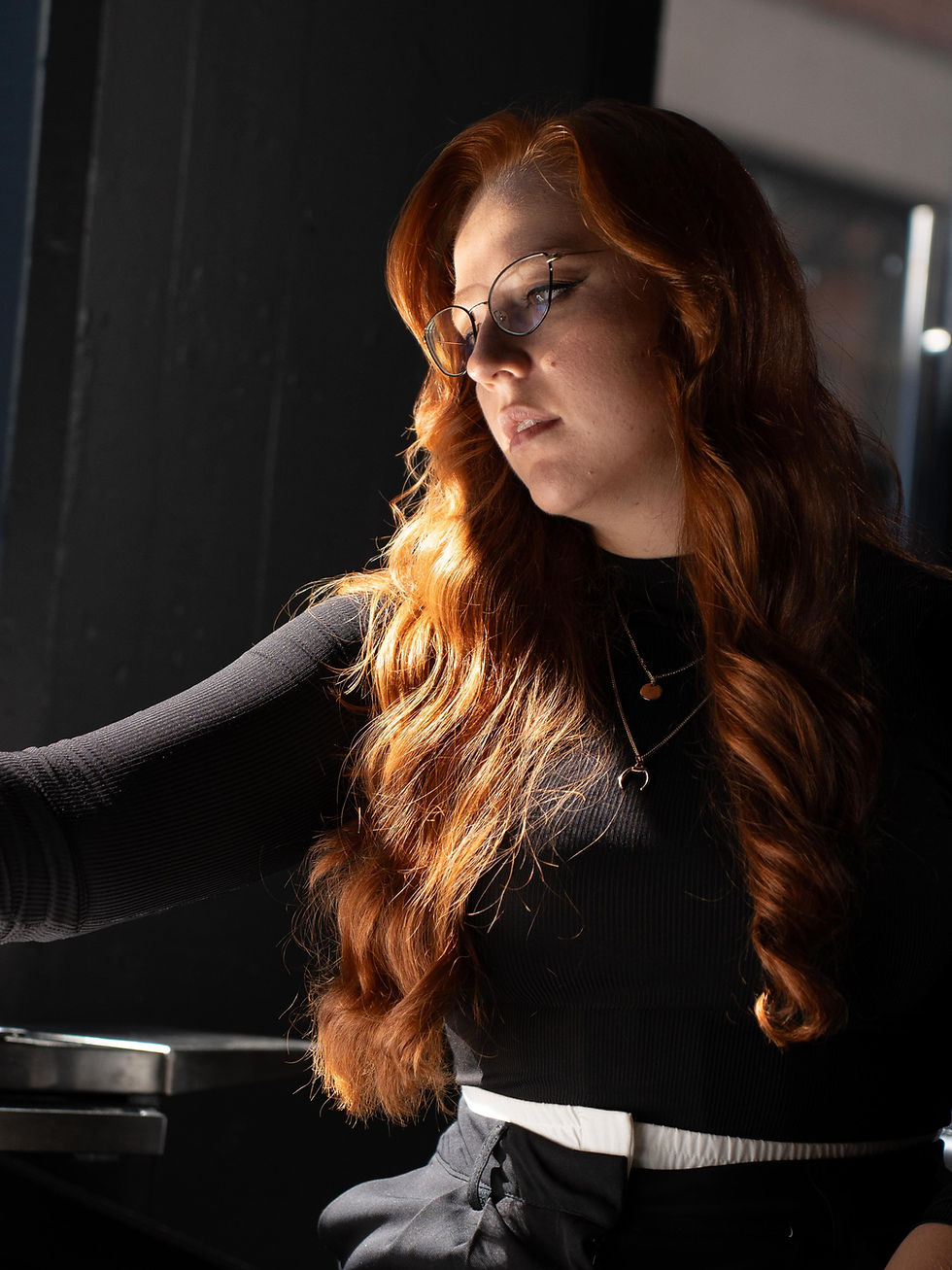
What motivated you to enter the world of tattooing?
The motivation came after I started tattooing, not before. It was never “I’ve dreamed of being a tattoo artist since childhood. It was more like: “oh, I tried it and I understand how it works. I know how to make it better. Let’s do it.” With every piece I made, I felt more and more that this is not the limit — and that I can go further. And more importantly, I could see how. Each tattoo shows me the next step of growth. I still feel like I’m learning.

What were your beginnings like? Your very first pieces?
At the very beginning, around 2016, my husband gave me a starter tattoo kit — basic machines in a wooden box. Kind of funny and not very practical, but that’s where it started. A couple of days later, we did the first tattoo on his wrist — his first and my first as well. It’s still there, unchanged, no touch-ups. A small symbolic marker of the beginning. After that, I did simple foundational pieces and learned through them. I value every tattoo I’ve done — for the trust people gave me and for the experience. One interesting fact: I almost never trained on fake skin. Over the years maybe 2–3 times, just to test specific techniques. And I never did free tattoos. Even the very first ones were paid — a small amount, but enough to keep responsibility and focus real.

How did you choose your style? What steps did you go through to achieve it?
My style is still evolving — I don’t see it as a final point. I went through different directions: Japanese, neo-traditional, graphic work, black and grey realism, and colour realism. For me, these aren’t “style changes” — they’re tools I use depending on the project. My architectural background shaped this a lot. It trains you to be versatile — painting, composition, sculpture, drafting. You learn to work across systems. So I feel comfortable building colour realism compositions using neo-traditional structure and adding graphic flat elements when needed.

Are there any aspects you would still like to improve as an artist?
Yes — development is just a natural part of it. Colour realism and surrealism are basically limitless, both technically and compositionally. That’s what keeps it alive for me. Experimentation is what pushes me forward. I’m open to personal experiments and collaborations with other artists. What I’m more afraid of is reaching a point where I say: “I’m already good enough.” That would mean stopping. And I can clearly see a long path ahead.

What are your plans for the remainder of the year?
We already have a list of conventions and we’re following it. The studio debuted at one of the biggest and oldest conventions in Toronto — NIX Tattoo Show 2026 — and we brought back the “Best of the Day” award. For the rest of the year, the focus is studio growth and development, as well as my own progress within the industry. I also want more space for sculpture and music, just to keep a healthier balance between work and life. Guest spots and travel are also part of the plan — it helps balance my need to move. I’ve already had positive guest experiences in Berlin, Stuttgart, Wrocław, Warsaw, Kraków, Calgary, and Edmonton. It gave me a clear understanding of how valuable international collaboration and different studio environments can be. I also see that my work is in demand and appreciated in different places, not just one location. That confirms for me that my visual language works beyond a local context. Next year I want to expand guest spots further across this continent and also explore more opportunities in Europe — not just for travel, but for experience, connections, and growth within the industry.

What were your experiences at conventions like?
My debut and experience both started at major conventions right away. It might sound unusual — most people start smaller — but that’s how it happened. I’ve always had a competitive mindset. Stage, sports, competitions — that kind of energy has always been part of my life. At conventions I don’t really “walk around.” For me it’s preparation, focus, pressure, execution. That very sharp mental state when you’re fully in it. Afterwards there’s always a crash — exhaustion and a very honest feeling that you gave everything you had. It’s also a chance to meet friends who are spread across different cities and countries. So far, every convention has brought not only experience but also awards — not as a goal, but as recognition of the work.

What does it mean to you to have achieved multiple awards and recognition?
Awards themselves lose their emotional impact fairly quickly. At first, they feel like a major event. Then they simply become part of the journey. What I value most is professional recognition. To date, every convention I have entered as a competing artist has resulted in an award for work completed during the event itself. That matters to me not because of the trophies, but because that kind of recognition reflects the level you are able to demonstrate here and now. They do not change my internal standards. The next day, I still see what can be improved and continue working. At the same time, awards are a clear signal of trust from both clients and the industry. What matters most is not the awards themselves, but what stands behind them — the process, the journey, and the work.

What was the process of setting up your own studio like?
Opening the studio wasn’t a spontaneous decision — it was a natural continuation of the path. Over time I’ve seen how different studios operate from the inside — different systems, different management styles, different relationships between artists and owners, including control mechanisms and pressure dynamics within the industry. That gradually shaped my understanding of what I want my own space to be. We opened the studio with my husband in Port Credit, Mississauga — intentionally outside the city centre, in a calmer and more human environment. For me, a studio is not a production line. It’s a space where independent artists can have their own voice and style. I don’t like large studio concepts where clients don’t even know who will be tattooing them. As I often say, good artists are like cats — they stay where they are treated well. Respect, atmosphere, and freedom to grow matter more than anything. Right now the focus is building the studio culture and finding artists who share the same values.
If someone wants to contact you, how can they do it?
The easiest way is through Instagram or the studio website. What matters more to me is not the format, but the person and the idea behind the project. I work on a wide range of projects — from smaller pieces to large compositions and full body work. If you’re looking for someone who works confidently and responsibly with a strong visual impact — just reach out wherever it’s easiest for you, and we’ll start a conversation. Most of the strongest projects always start exactly like that.
Any special message?
Tattooing has never been about finding a comfortable place for me. I have always been more interested in going where the standards are higher, the competition is stronger, and results are proven through work rather than words. That is probably why I still love conventions, new projects, new cities, and new challenges. Not because they are easy, but because that is where growth happens. I am not trying to become a better version of someone else. I am far more interested in pushing the boundaries of my own abilities and remaining among the people who continue to raise the standard of this industry through their work and example.


Comments