


Alex Zakharov Warsaw - Poland @zakharovtattoo Facebook: Attachment.png TikTok: Attachment.png

There are career paths measured in trophies, and others measured in evolution. Alex’s journey is a perfect symbiosis of both, but to truly master his work, one must first understand the three distinct facets that define him.
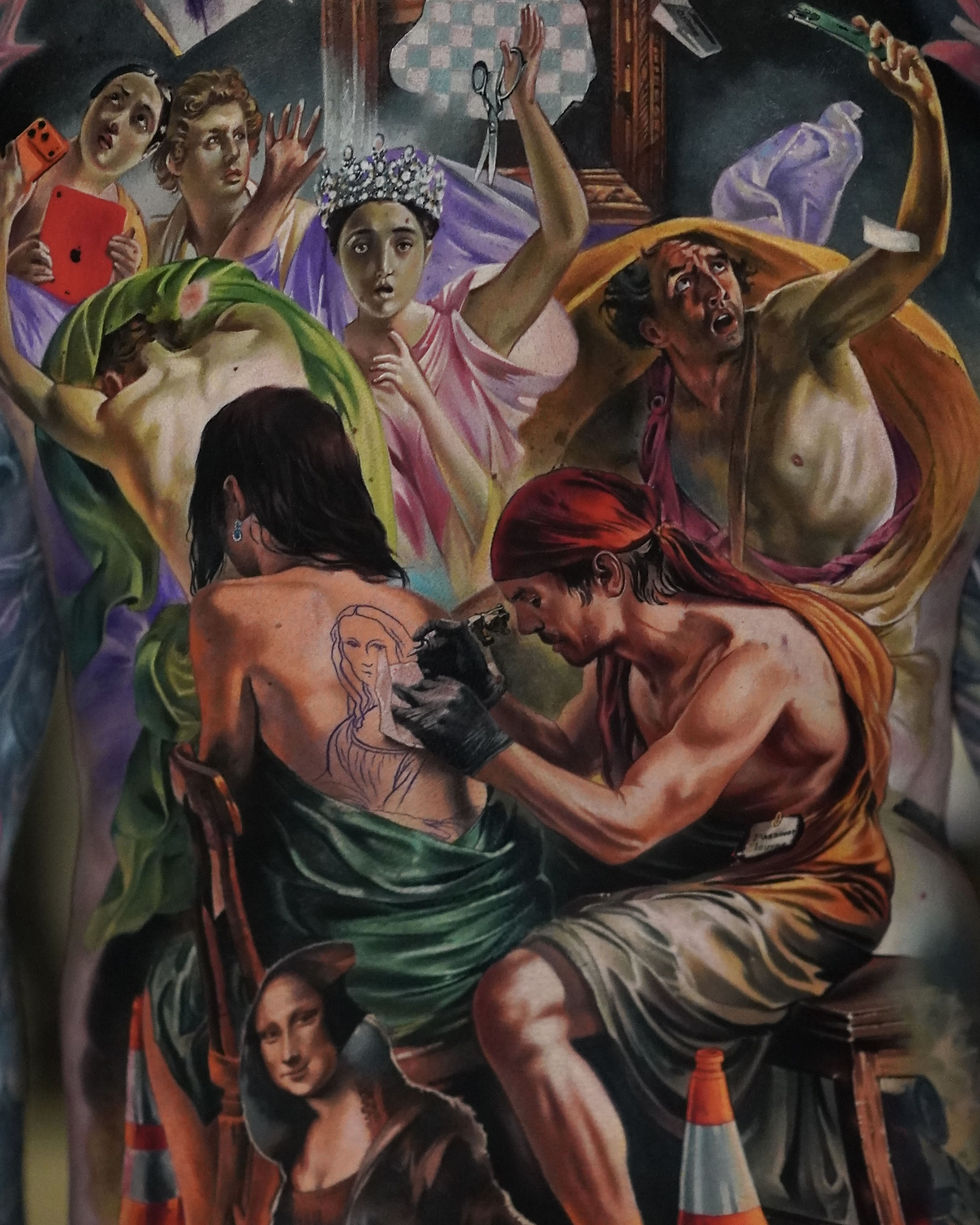
As an artist, Alex has managed to blur the line between contemporary tattooing and fine art, bringing the dramatic light of Caravaggio and the texture of aged canvas to living skin through his celebrated "cracked skin" effect. As a human, his path is forged from pure resilience: from his humble beginnings in Ukraine and the grueling days split between construction labor and late-night tattooing in Poland, to a life deeply rooted in the noblest values—such as honoring his father's memory and embracing the unwavering support of his wife. Yet, perhaps his most magnetic facet is that of the student. Despite holding over a hundred international awards and leading his own creative sanctuary, Sagma Tattoo Gallery, Alex maintains an unshakeable humility. For him, art does not tolerate ego; every session, every healing process, and every question from his apprentices represents a new lesson in a classroom that never closes.
We sit down to converse with a brilliant mind who, before leaving ink on the body, seeks to leave an enduring impression on the soul, reminding us that the true master is the one who never stops learning.

1. What were your beginnings in tattooing like? Did you experiment with different styles first, or did you always know realism was your path?
From a very young age, I was drawn to pencils, paints, and drawing. While I was in school, I was constantly sketching—during lessons, at home, anywhere I could. I would fill entire sketchbooks with drawings, and when they were finished, I even drew directly on school desks with pencils, erased them, and started over again until my parents bought me a new sketchbook.
When I was in sixth grade, my art teacher noticed that my level was much stronger than the other students. He even allowed me to ignore the class assignments because he understood that I needed to develop in my own direction. Later, he advised my parents to enroll me in an additional art school. They agreed, and on weekends I started attending the best art school in my city.
When I entered that school, I immediately skipped several levels because of my drawing skills. There was an elderly teacher there whose oil paintings could captivate anyone. He taught a group of around twenty students, all of them very talented, and I was about thirteen years old at the time.
Over time, I realized I had become his favorite student. He taught me the fundamentals of drawing and painting at a very deep level. Back then, I spent countless hours drawing still lifes, geometric forms, plaster sculptures, working with watercolor and pencil. At that age, I wanted to paint nature or fantasy subjects instead of endless academic studies, but he never allowed it. Years later, I understood why. Those exercises trained my eye so precisely that I learned to transfer form and proportions almost millimeter by millimeter.
Later, he prepared me for admission to the best art university in Kharkiv, Ukraine. I had to prepare twenty strong works—ten paintings and ten drawings. Unfortunately, my family could not financially afford that education. I grew up in a poor family, so instead I entered a different art college. It was not as prestigious, but I continued developing my skills there, especially in oil painting.
After graduation, I painted constantly, worked on commissions, and sold oil paintings. One day, while I was painting at home, my father came to visit and brought me tattoo equipment. He told me:
“Son, try tattooing. It’s going to become something big.”
At that moment, I knew absolutely nothing about tattooing, but I became curious. The first tattoo I ever tried was a tribal piece on my sister’s lower back, copied from a tattoo book. The moment I started pulling the first line, everything went wrong. The ink smeared, the lines were crooked, and the machine felt completely uncontrollable.
That was the moment I realized something important: even though I could paint realistically with oils, I still couldn’t pull a clean line on skin. Tattooing completely destroyed my confidence as an artist.
I told my father that tattooing wasn’t for me, that I didn’t understand the machines or the process. But he answered:
“I’ll figure it out.”
A few days later, he took me to a tattoo artist working in what looked like a basement or garage. I still remember the smell of Dettol there. That artist showed me basic things—how to apply stencil, how to tune a machine, how to work with needles—but at the time it felt like a completely different universe to me.
I kept trying. I tattooed friends and even my father. He loved the tattoos, but I could only see mistakes and poor quality. Eventually, I almost gave up on tattooing entirely and even stepped away from art for some time. I worked many different jobs—construction, bartender, waiter, sawmill worker, furniture sales—just trying to survive.
In 2020, while already living in Poland, I decided to give tattooing one more chance. I bought my first Cheyenne pen machine and started learning through YouTube videos. That was when I realized how much equipment matters. Slowly, things started improving. During the day I worked construction, and in the evenings I tattooed my coworkers at home.
Word of mouth started spreading. At that time, I lived in a small Polish town called Stargard. Every morning I left for construction work at 6 a.m., and every evening I returned home and tattooed until midnight.
One day, I booked an appointment for myself at a professional tattoo studio just to get tattooed. The moment I walked inside, my world completely changed. The atmosphere, artists covered in tattoos, iPads full of designs, professional machines, conversations only about tattooing—it felt like I had entered the job of my dreams.
After that experience, my wife and I started searching for studios that might give me a chance. But everyone rejected me because my portfolio was still weak.
A few months later, one studio in another Polish city finally agreed to take me. It was in Łódź, around 400 kilometers away from where I lived. I left everything behind for the dream of working alongside tattoo artists.
Later, I was invited to Warsaw into a much stronger studio with many artists and a solid flow of clients. November 13th, 2020 became the date that completely changed my life.
There, I absorbed everything like a sponge. I learned from different artists, asked even the most basic questions, studied machines, needles, and techniques. But from the very beginning, realism was the only style that truly interested me. I always remained a realist painter at heart.
It took me about a year to truly understand the needle and the skin. I started in black & grey realism, and later slowly transitioned into color. Color was much harder for me, but after another year I finally felt that I had mastered it as well.
On August 1st, 2024, I opened my own studio—Sagma Tattoo Gallery. By that time, many artists wanted to work with me. I carefully selected people who matched my mindset and energy, and I started teaching them my techniques, knowledge, and artistic approach.
Today, we have a very strong team, and every artist in the studio carries part of my vision and technique.
2. Was there a particular canvas, painting, or mentor that made you say: “This is what I want to translate onto skin”?
Since childhood, I’ve always been deeply inspired by classical painters. Even today, I continue learning from them, analyzing their work, and trying to understand how they thought through light, composition, anatomy, and color.
The artists who influenced me the most are Raphael, Leonardo da Vinci, Michelangelo, and Caravaggio. To me, they are not just legendary painters—they are masters who could create emotion through form, light, and movement. Especially Caravaggio. His understanding of light and depth still amazes me today.
When I study classical paintings, I don’t look at them simply as a viewer. I analyze them technically—the color palette, temperature shifts, transitions, shadows, composition, and atmosphere. Then I try to transfer that understanding into tattooing.
That was probably the moment I realized I wanted to dedicate myself to realism tattooing. I never wanted to simply place images on skin. I wanted tattoos to feel like living paintings.
My first art teacher also had a huge impact on me. As a child, I thought he was too strict because he forced me to endlessly draw plaster forms, still lifes, and academic studies. Years later, I realized he was teaching me how to truly see form, light, and detail. That academic foundation still helps me in every tattoo I create.
Even today, I continue learning from classical artists. I believe art has no final destination. The more you grow, the more you realize how much there still is to learn.
3. Realism evolves in subtle but powerful ways—texture, depth, light. When you compare your work from five years ago to your work today, where do you see the biggest growth, technically or conceptually?
When I look at my work from five years ago, I see someone who was still in a constant state of learning and searching. At that time, I already had a strong artistic foundation, but I didn’t truly understand tattooing yet. And those are two completely different worlds.
It took me more than two years to fully rebuild my mindset from painting into tattooing. On canvas, you can work in layers, fix mistakes, and come back to a painting whenever you want. Tattooing is different—there is no undo button, and you work on living skin that constantly changes.
Today, I understand that knowledge is the most important thing in this profession. Not only talent or drawing ability, but understanding the process itself: how skin behaves, how pigment settles, how contrast ages over time, and how a tattoo will look years later.
In the past, I only wanted to create beautiful tattoos. Today, I think much deeper—about longevity, body composition, movement, and how the tattoo will live together with the person wearing it.
One of the hardest parts for me was color. In black & grey realism, I felt more confident because of my academic understanding of light and form. But color tattooing is an entirely different language. It took time to understand color temperature, saturation, balance, and how different tones interact with different skin types.
My understanding of detail has also changed dramatically. Years ago, I believed realism was simply about adding as many details as possible. Today, I understand that true realism is built through atmosphere, depth, and light. Sometimes one soft shadow gives more life to a tattoo than hundreds of tiny details.
Today, learning tattooing is much more accessible because of the internet, online education, and social media. When I started, there was almost no information available to me. Many things had to be understood through mistakes, failures, and years of practice.
But I believe that difficult path shaped me as an artist. And even today, I continue learning every single day. The more you evolve, the more you realize how endless the world of art and tattooing truly is.

4. What kind of projects or compositions still give you that feeling of awe — the kind that reminds you you’re still a student?
As someone once said:
“The best teachers are our students.”
Today, I not only work as a tattoo artist, but also teach other artists—both inside my studio and through group and individual workshops. Sometimes the questions students ask force me to think even deeper about the things I do every day. There are moments when you explain a technical detail to someone else, and suddenly you begin seeing the process from a completely new perspective yourself.
I believe a true artist should never feel like they already know everything. The moment a tattoo artist starts thinking they are the best and have nothing left to learn, that is the moment they stop evolving. Art does not tolerate ego. It will always remind you how endless this world truly is.
I constantly analyze my own work. After every project, especially once the tattoo is healed, I study it carefully again and again. I think about what could have been improved—where the composition could be stronger, where the light could be softer, where the form could have more depth. For me, growth never ends when the session is finished. Sometimes the real learning process begins after healing.
The projects that still give me the strongest feeling of respect and excitement are large-scale compositions with emotional depth—full backs, complex storytelling pieces, religious themes, and classical-inspired projects. Especially the kind of work where you are not just applying a tattoo technically, but creating atmosphere and emotion directly on the human body.
Those projects remind me that I am still a student myself. Because the bigger and deeper the project becomes, the more you realize how important it is to stay humble, observant, and always willing to learn.
5. What did your first major convention awards give you on a personal level? Did they change the way you approach your work every day?
I received my very first award in June 2022. For me, it was an incredibly emotional moment. At that time, I still didn’t fully understand how tattoo conventions worked, and honestly, I never even thought I could win anything. I simply wanted to present a strong tattoo and be part of that atmosphere.
But after that first victory, something changed inside me. I became even more motivated to create meaningful projects and show people that tattooing can truly be art. I started traveling to more conventions, meeting artists from around the world, studying the level of work around me, and constantly raising the standard for myself.
Later came more awards, and eventually I won my first Best of Show. For me, that felt completely unreal. Not long before that, I had been working construction jobs during the day and tattooing at home at night. Suddenly, I was standing on stage among some of the strongest artists in the industry.
Today, I have more than 100 awards, including The Crystal Needles Awards. But honestly, the trophies themselves are no longer the most important thing for me. What matters more is the journey behind them—the months of preparation, the emotional and physical energy invested into every project, the sleepless nights, and the responsibility toward both the client and myself.
Over time, conventions stopped being about winning cups and trophies. I started attending them for the atmosphere, the energy, the connection with other artists, and the opportunity to show projects with deeper meaning and artistic vision.
There was one moment at a convention in Poland where I entered three healed tattoos and won first, second, and third place at the same time. Instead of feeling proud, I actually felt uncomfortable toward the other artists competing. After that experience, I decided not to submit multiple healed tattoos in the same category anymore. I believe respect and balance inside the industry are important.
Another important moment in my journey was the video where I burned all of my awards. Many people misunderstood that act. But for me, it was an artistic statement and part of a larger concept. The meaning was never about destroying the trophies—it was about showing that the real value is not in metal or awards. The real value is the art that stays on someone’s skin forever.
After that, I created a tattoo project in which all of those awards symbolically continued to exist. They became part of the artwork itself rather than objects sitting on a shelf.
At some point, I realized that conventions were no longer about competing against other artists. They became a competition with myself. Every new project is an attempt to become stronger, deeper, and better than I was yesterday.
And even now, after all the awards and recognition, I still feel like the same person who once dreamed about simply working inside a good tattoo studio. The only difference is that now the responsibility is much bigger. People expect powerful projects from me, and that pushes me to work even harder and never allow myself to stop evolving.
6. Tattooing used to be a very solitary craft, but you actively collaborate with other artists. Coordinating two minds, two styles, and two machines on one project is a huge challenge. How do you share space when working together on the same piece?
For me, the most crucial element in any collaboration is the project itself. The goal is never to prove who is superior or whose style holds more weight; the ultimate objective is to co-create a single, cohesive, and powerful piece of art.
Most of the collaborations I’ve undertaken were built around my initial concepts and compositional planning. Thanks to my academic background in fine arts, I have a deep understanding of large-scale compositions—specifically how to balance movement, anatomy, light, and flow on the human body. When executing massive projects, particularly back pieces or full-body suits, you have to think not just as a tattooist, but as a painter.
Fortunately, I have never experienced conflicts during joint projects. I believe everything comes down to mutual respect and the ability to listen. I am always open to another artist’s perspective; if a suggestion enhances the work, we adjust it together, leaving egos aside. The most successful collaborations happen when everyone feels like an integral part of a single creative process.
Energy is also vital to me, which is why I carefully select my collaborators. Technical skill is undeniable, but synergy matters just as much. When everyone operates on the same wavelength, the process becomes natural, fluid, and deeply inspiring.
I love collaborating because a monumental composition can be born in just a few days—something that would take much longer to achieve alone. There is a distinct magic when multiple artists align their strengths toward a single vision.
During the process, we usually divide the work into specific elements while constantly ensuring the final piece remains fully unified. One artist might focus on intricate details, while another emphasizes atmosphere or texture, but the ultimate goal is for the tattoo to look as though it came from a single hand, rather than a clash of disconnected styles.
Ultimately, collaboration is not about ego. It is about trust, respect, artistic chemistry, and the opportunity to create something far greater than one could ever achieve alone.
7. What projects, conventions, or directions are currently shaping your path over the next few months?
Right now, my primary focus is creating tattoos with profound meaning—pieces that resonate as true fine art. I want to evoke the emotion and depth of classical painting. In many of my current works, I seek to breathe new life into classical art by blending elements of Renaissance and academic painting with contemporary tattooing and the modern world.
I am constantly searching for ways to bridge the gap between tattooing and fine art. I don’t want tattoos to be viewed merely as body ornamentation. It is essential to me that a tattoo carries an atmosphere, a narrative, and a deeper emotional weight, much like a masterpiece in a gallery.
One signature element people recognize in my work today is the "cracked skin" effect, inspired by old master paintings and the texture of aged canvas. I was the first to introduce this concept into realism tattooing in this specific form. Seeing other artists draw inspiration from it and develop similar concepts genuinely makes me happy; it means my ideas are helping push the industry forward and opening new creative avenues within realism.
Another major focus is elevating Sagma Tattoo Gallery to an international level. I want it to be more than just a studio—I vision it as a sanctuary where elite artists can grow together, exchange knowledge, and inspire one another.
Very soon, I will be traveling to Brazil to host new seminars and educational workshops. Teaching has become a deeply rewarding part of my journey. I’ve realized that I genuinely love sharing knowledge and witnessing the growth of fellow artists.
At the same time, I understand that the knowledge I impart is dense and requires time to fully mature. For instance, one of my students needed nearly a year to completely absorb and apply the techniques I taught him. Real mastery does not happen overnight—it demands practice, discipline, and immense patience.
I also have several international conventions lined up in the coming months, including dates in Venice and Switzerland. Conventions remain a great source of inspiration for me, as they offer the opportunity to connect with world-class artists, exchange energy, and keep pushing my own creative boundaries.
I feel I am entering a new chapter where tattooing, classical art, education, and large-scale artistic ventures are merging into a singular, grander vision and philosophy.
8. If a young artist approached you at a convention and asked for just one piece of advice—what would be the most important truth about this profession that you would share?
If I had to give a beginner just one piece of advice, it would be this: never underestimate the importance of high-quality equipment.
Many young tattooists start out with weak machines, poor-quality cartridges, or unstable power supplies. Consequently, when things go wrong, they begin to doubt their own talent and assume the problem lies in their hands. By investing in premium equipment, you eliminate a massive variable of unnecessary technical issues. You stop asking yourself, "Is the machine malfunctioning?" or "Is it a faulty cartridge?" At that point, execution depends entirely on you—your experience, knowledge, discipline, and control.
However, top-tier equipment is meaningless without relentless practice. True mastery in tattooing requires years of training your hand, eye, and mind to operate as a unified system.
I trained my hand from a very young age through drawing and painting. Over time, your hand begins to execute your thoughts automatically, but that level of muscle memory only comes after thousands of hours of dedication.
Consider this simple test: try holding a tattoo machine in your non-dominant hand and tattooing with it. It will immediately feel awkward, weak, and uncontrollable. This isn't because the hand itself is inherently bad—it simply lacks experience. Tattooing operates on the exact same principle. You must train your hand through endless repetition until it can flawlessly translate what you envision in your mind onto the skin. There are no shortcuts.
I think one of the biggest pitfalls for young artists today is the desire for immediate results. Social media creates the illusion that you can become an elite artist in a matter of months. In reality, true skill is forged through years of discipline, mistakes, frustration, continuous learning, and an immense volume of work. Talent is a factor, of course, but discipline and consistency are what truly matter.
Ultimately, the most profound truth I’ve learned over the years is that tattooing is not just about placing beautiful imagery on skin; it is a monumental responsibility. You are leaving your work on someone’s body for life. Every line, every shadow, and every decision carries permanent weight.
If you truly want to become a great artist, you must fall in love not just with the final result, but with the endless, lifelong process of learning itself.
9. If someone wants to get in touch with you, what’s the best way to do it?
The best way to reach me is through Instagram at @sagma.tattoo.gallery.
That is our primary channel for inquiries regarding tattoo appointments, collaborations, conventions, seminars, and educational projects. My team and I are always eager to connect with people who share a genuine passion for art and tattooing, and we welcome meaningful, avant-garde artistic concepts.

10. Is there anything else you’d like to say? Any acknowledgments or final thoughts?
First and foremost, I want to thank my wife. She has been by my side throughout this entire journey—from the most challenging moments to our greatest victories. She has always respected my decisions, supported my vision, and believed in me even when I doubted myself. Without her, none of this would have been possible.
I also want to honor the memory of my father. Regrettably, he is no longer with us and never had the chance to see the artist I have become. However, he was the very first person to encourage me to pursue tattooing, and he gifted me my first set of equipment. In many ways, he was the guide who set me on this path.
Additionally, I would like to express my deepest gratitude to my art school mentor. He didn't just teach me how to draw; he shaped my entire artistic identity. Much of what I apply today in tattooing—my understanding of form, light, composition, and painterly values—was built during those formative years of education.
I am also profoundly grateful to my mother and my entire family for their unwavering support and belief in me throughout my life.
A special thank you goes to my team at Sagma Tattoo Gallery. To me, it is no longer just a studio; it is a true family, a collective of individuals with whom I continue to grow, evolve, and push the boundaries of art.
I am also immensely thankful to Mateusz and Kasper—the mentors who originally gave me an opportunity and welcomed me into their studio. That specific chapter of my career played a pivotal role in my artistic development.
And, of course, I am grateful to my students. Through teaching, I continue to learn. They constantly motivate me to become a better, deeper, and stronger artist and individual.
Ultimately, the legacy I wish to leave behind is not simply a portfolio of beautiful tattoos, but the enduring impression that tattooing can be elevated to the level of fine art—something capable of evoking deep emotion and existing on a far more profound level than mere ink on skin.


Comments